Market Summary
The French CAC 40 index closed lower, down 0.84% to 8,157.82 points, with a high trading volume of €4.125 billion. Over the past week the index has lost about 3.2%.
Investors are nervous because the United States continues a naval blockade of Iranian ports, trying to pressure Tehran. In retaliation Iran has limited ships passing through the Strait of Hormuz, a vital route for world oil trade. This back‑and‑forth adds uncertainty to the markets.
There are diplomatic signs that could calm the situation. Iran’s foreign minister, Abbas Araghchi, is expected to travel to Pakistan to discuss a possible dialogue with the United States. An American team is reportedly already on the ground preparing for talks.
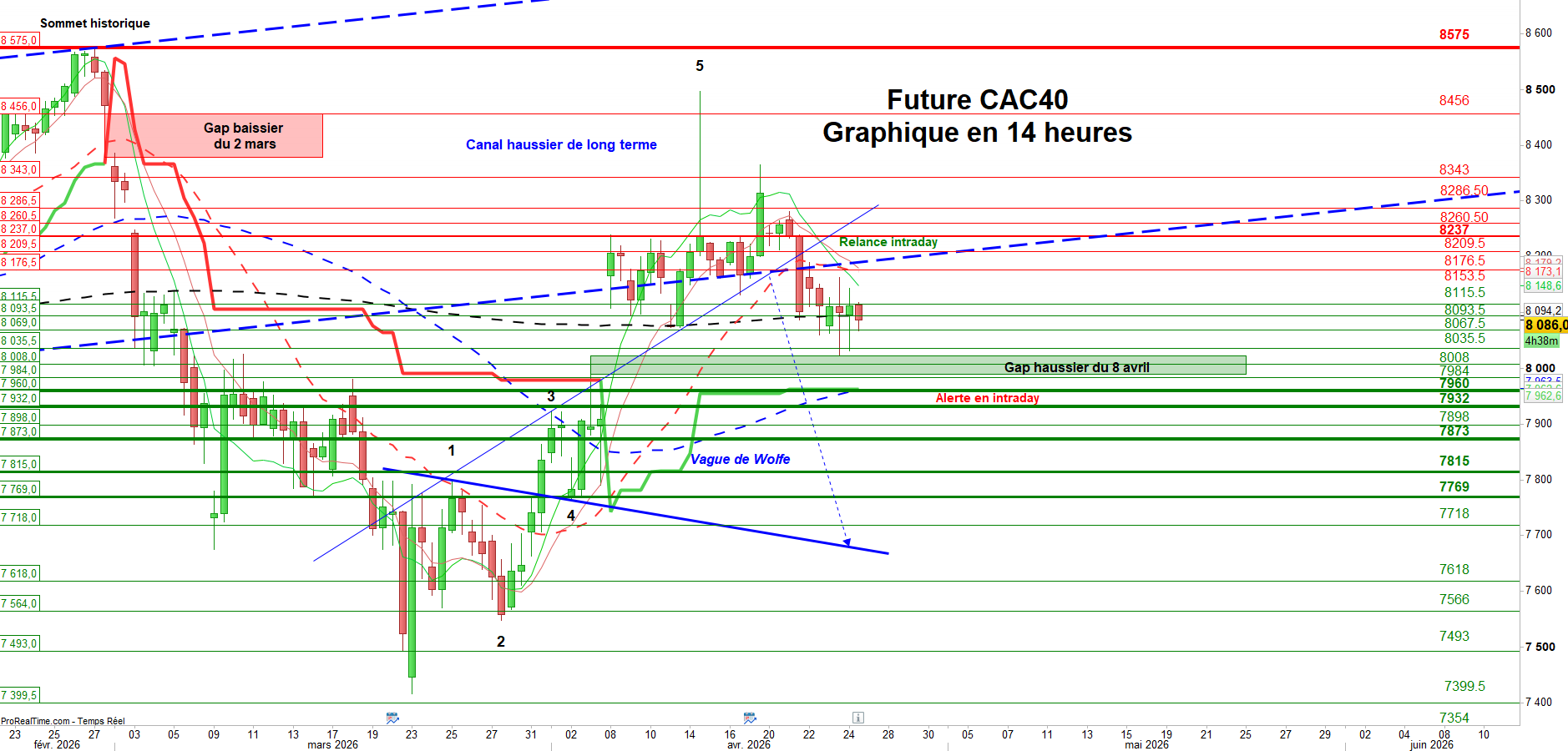
Future May Contract – Key Levels
Resistance levels: 8,093; 8,115; 8,153; 8,176; 8,237; 8,286; 8,332; 8,475; 8,652.5
Support levels: 8,035; 7,984; 7,898; 7,815; 7,769; 7,718; 7,618; 7,566
During the day, the market is biased lower, staying under the 8,160‑point mark.
Technical Outlook
The chart for the CAC 40 future (as of 14:00) shows a short‑term downtrend that started after a reversal pattern on 21 April. The pattern is a Wolfe wave, pointing to a target zone between 7,680 and 7,640 points.
One important support is the bullish gap opened on 8 April, which sits between 8,111.17 and 8,051.18 points on the cash index. The gap is still open, creating a roughly 80‑point gap between the future and the cash market. If the gap fills, it could push the market into a longer consolidation phase.
To break the current downtrend, the index would need to rise above the lower edge of the long‑term upward channel around 8,200 points and then clear the high of 17 April at 8,365.5 points.
Technical indicators are mixed: the MACD histogram is trying to climb but stays low, the RSI is neutral, and volumes are slightly below last week’s levels, showing investor caution.
What Could Happen Next?
If the price falls below the bottom of the April 8 gap, the market may keep sliding toward the next support zones: about 7,960 points, then 7,930 points, and finally 7,815 points, before reaching the Wolfe‑wave target near 7,680‑7,640.
Conversely, a strong move above 8,200 points could invalidate the bearish bias and open the way for a rebound.
Conclusion
Because the Wolfe wave suggests a short‑term decline, we have trimmed dynamic and investor portfolios and added protective hedges. The geopolitical backdrop remains volatile, so we stay ready for both a possible rebound and further weakness if the April 8 gap fills.