
Before we start…
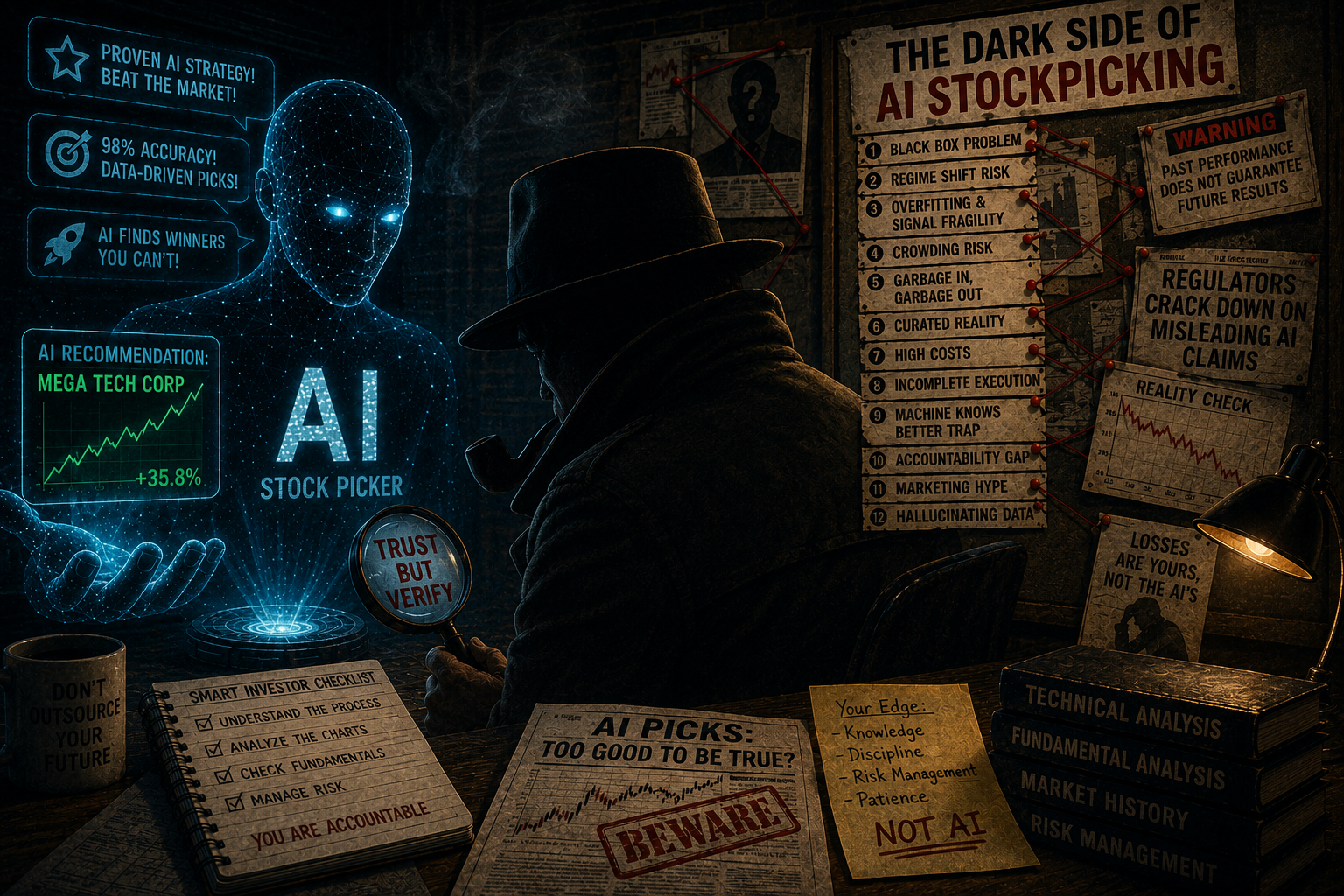
We are at the beginning of a new age driven by artificial intelligence (AI). Some people think AI will solve everything, while others think it will bring disaster. In reality, AI is a powerful tool that can help us work faster. But using it for money decisions can be risky. The system works like a black box – we can’t see inside. We don’t know which data it uses, what it might miss, or if it makes up facts.
If the AI makes a bad call, you lose money. So, would you let a machine run your portfolio? Some investors already do.
There are many ads promising AI‑generated stock picks that are perfect, fast, and easy. What you rarely see is the downside. Before you trust an algorithm, read the ten risks most AI stock pickers don’t talk about.
1. The Black‑Box Problem
An AI tool may suggest a good stock, but it often won’t explain why. You won’t see:
- What factors led to the choice
- Which variables mattered most
- How the idea has changed over time
In short, you can’t check what you can’t see. If the service won’t show its logic, you must do your own homework or risk trusting a secret process.
2. Regime‑Shift Risk
AI learns from past data. It may not notice big changes, such as interest‑rate shocks, wars, earnings misses, or supply‑chain problems. The model might keep using old patterns even when the market has moved on.
Human insight can spot these shifts. If the AI doesn’t tell you when the rules change, you could be following a plan that no longer fits reality.
3. Overfitting and Fragile Signals
Sometimes a model fits past data too tightly. It may focus on one technical or fundamental signal and ignore everything else. What worked before may be useless tomorrow.
The result is a system that looks great in back‑tests but fails when real money is on the line.
4. Crowding Risk
Many AI tools train on the same public data. They can all pick the same stock. When the idea turns sour, many investors may sell at once, driving the price down faster.
5. Garbage‑In, Garbage‑Out
AI only works as well as the data it receives. If the financial statements, market feeds, or third‑party data are wrong, old, or biased, the AI’s output will be flawed too.
6. Curated Reality vs. Market Reality
If a model is trained on only successful companies, it misses the messy parts of the market. Real stocks often have rough periods, even if they later become giants.
Looking at history with a rose‑colored filter can give you a false sense of safety.
7. High Costs and Hidden Friction
Short‑term AI trading can create many trades. Each trade costs fees, commissions, and may suffer slippage. Even a good signal can lose money after these hidden costs are added.
8. Incomplete Execution Guidance
An AI may tell you what to buy and when, but it often ignores how much to buy, where to set stop‑losses, or when to add or reduce a position. Execution details often decide whether a trade makes money.
9. The “Machine Knows Better” Trap
When an AI seems to work, you might become over‑confident and stop doing your own analysis. Your own skills can weaken, and you may follow a bad signal without questioning it.
10. The Accountability Gap
If an AI‑generated pick causes a huge loss, who is to blame? The model, the platform, or you? Without clear responsibility, you miss the chance to learn from mistakes.
AI Used as a Marketing Weapon
Some companies exaggerate AI performance. They may show simulated results as real, or even fake track records. Regulators like the SEC are starting to warn about these practices.
Always ask hard questions. Your money deserves it.
Where AI Actually Helps
If you use an AI stock picker, treat it as a research tool, not a final decision maker. It can help you find ideas and spot patterns, but you still need to:
- Check the pick yourself
- Decide how much to risk
- Watch execution costs
Use charting tools to confirm price behavior and keep an eye on risk.
Key Takeaways
- If you can’t explain a pick, skip it.
- Think of AI suggestions as hypotheses, not facts.
- Always verify with charts and your own analysis.
- Be skeptical of loudly promoted “AI picks.”
- Simpler systems you understand often beat complex black boxes.
AI tools are growing fast, but they don’t replace careful thinking, context, and risk management. The biggest danger is not a wrong call, but an over‑confident wrong call that hurts a lot.
Source: Materials provided by https://articles.stockcharts.com.Note: Content may be edited for style and length.