
Market Overview
The CAC 40 cash index closed down 0.19% at 8,041.81 points, with an average daily volume of €3.943 billion.
The Paris market stayed under pressure even after the International Energy Agency (IEA) decided to draw heavily from its strategic reserves. The move aims to calm oil prices, but the result is still unclear because shipping through the Strait of Hormuz remains blocked.
Recent attacks on several vessels in the Hormuz Strait and the Persian Gulf have disrupted traffic for the twelfth day of the conflict. To help lower prices, all 32 IEA members unanimously agreed to put 400 million barrels of oil from emergency stocks onto the market.
This is the biggest release ever planned by the agency. By comparison, only 182 million barrels were released in 2022 after Russia’s invasion of Ukraine. Many investors think this is only a short‑term fix while tensions keep the oil market shaky.
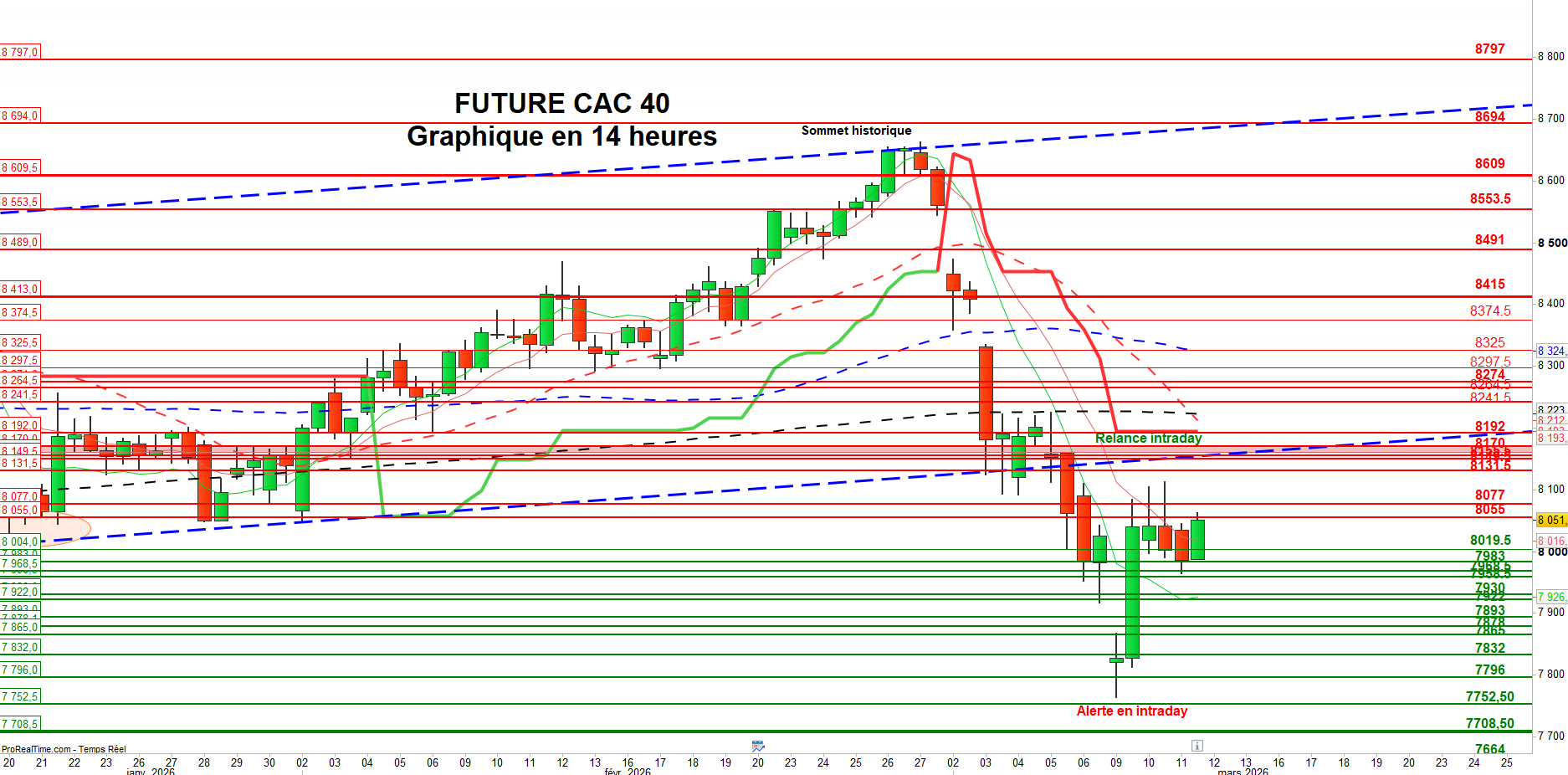
Future March (CAC 40 Futures)
Resistance levels: 8,055 – 8,077 – 8,131 – 8,170 – 8,192 – 8,241 – 8,274 – 8,325 – 8,415 – 8,551 – 8,632 – 8,810 – 8,910
Support levels: 8,019 (or 7,991.5) – 7,873 (or 7,853) – 7,831 – 7,740.5 – 7,615.5
In intraday trading, the bias is bullish above 7,916 points.
Technical View
The 14:00 chart of the CAC 40 futures shows a small “feverish” pattern. The partial closing of the bullish gap that opened the day before suggests the surge on March 10 was not strong enough to create a lasting upward push.
The index has not yet re‑entered its long‑term upward channel, which was clearly broken on March 5. Getting back into that channel would be a key step toward confirming a real trend improvement.
For now, the move looks like a simple technical bounce. It will only gain credibility if the price manages to re‑enter the long‑term bullish channel.
On the indicator side, the MACD histogram is trying to rise but stays near the bottom of its range. The RSI has just left the oversold zone and is attempting to recover. Trading volumes remain solid, though slightly below last week’s peak.
If the price falls below the middle of the large bullish candle from March 9 (the “marubozu” at 7,948.50 points), the technical rebound could weaken. The risk grows if the close drops under 7,900 points.
As long as the weekly close stays above that level, the medium‑term bullish bias should stay intact.
Conclusion
The recent correction was halted by reassuring comments from Donald Trump, which gave the CAC 40 a chance to bounce. The rebound will need confirmation by re‑entering the long‑term upward channel – the first step of a possible recovery that remains delicate due to the ongoing Iran‑related conflict.
Investors may consider gradually strengthening dynamic and investor‑type portfolios as the bounce confirms, while staying ready to trim exposure if technical signals turn negative.