

Richard D. Wyckoff spent many years watching Wall Street. He first ran errands, then sold stocks, and finally became a famous analyst. He saw that the market does not move by chance. Instead, it follows a plan set by smart, patient players.
Big groups of investors act like armies. They run separate but similar missions called campaigns. One campaign may be an accumulation phase, where they quietly buy shares. Later comes a distribution phase, where they sell. Between these phases the market goes up (markup) or down (markdown). Traders call these repeating patterns market cycles. The cycles are like the heartbeat of stocks, bonds, and commodities.
Wyckoff noticed that a few of these large players were very successful. They gathered huge piles of money and moved it in and out of their favorite stocks. To stay hidden, they kept their buying and selling quiet. If they shouted about their trades, other big investors might jump in and change the price before the original plan finished.
Wyckoff gave these secretive, powerful traders a name: the Composite Operator (sometimes called the Composite Man). He learned to read their footprints on price charts. Even though they tried to stay hidden, the charts still showed their actions. By watching price and volume, Wyckoff could tell when the Composite Operator was getting ready to move the market.
Wyckoff’s student, Dr. Henry O. Pruden, called the Composite Operator a “heuristic.” That means it is a useful idea, not a real person. In reality, the Composite Operator is a group of very large, very skilled investors. Each one works on its own, but they often act in similar ways. Most of them are institutions, but a single person can become a Composite Operator if they trade enough money over a long time.
The goal for anyone who follows Wyckoff’s method is simple: first, spot the current campaign run by these big players. Second, watch price and volume to see when the accumulation phase ends and the markup phase starts. Third, enter the trade at that moment and ride the move alongside the Composite Operator. In Wyckoff’s view, timing is everything.
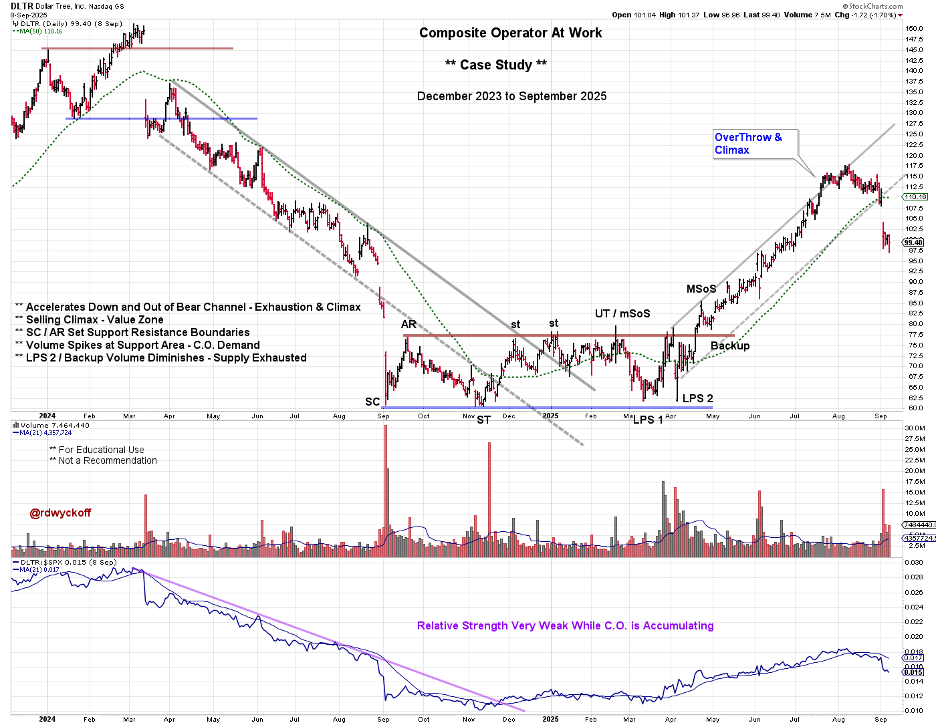
Take the stock Dollar Tree (DLTR) as an example. Over several months, the price stayed near a strong support level. Each time the price touched that level, the volume spiked dramatically. Only very large buyers can create such huge volume. This shows that powerful investors were quietly buying at the support area. After about eight months of this steady buying, the stock began a strong up‑trend. When the trend later slowed and the price broke below a key channel, it hinted that the upward move was tiring and a new accumulation phase might be starting.
Wyckoff’s teachings are meant for education only. They do not replace personal financial advice. Always consider your own situation and, if needed, talk to a qualified professional before making any trade.
Source: Materials provided by https://articles.stockcharts.com.Note: Content may be edited for style and length.