


Seeing a weak market can make you want to buy the dip. Right now the charts say to be patient. The market still looks bearish and even experts are uneasy.
When we look at the charts, it’s clear that chasing new long positions isn’t a good idea. Long‑term investors should stay calm and let the market speak for itself.
Narrow Strength and Higher Volatility
Only three S&P sectors – Energy, Utilities, and Communication Services – have more buyers than sellers. That means overall bullish strength is weak. Transportation and semiconductor stocks are doing a little better, but the broad market stays fragile.
Volatility is climbing, with the VIX index edging toward 30. Outside stocks, oil prices rise, precious metals fall, the 10‑year Treasury yield is about 4.41 %, and the U.S. dollar is gaining strength. All of this adds selling pressure to the stock market.
Geopolitical tension, especially the Iran conflict, shows no signs of easing. As long as uncertainty remains, stocks may keep slipping. Jumping in too early could feel like trying to catch a falling knife.
In this climate, keep a close eye on the big indexes.
S&P 500 Support Level
The S&P 500 closed near the bottom of its range on Thursday. That was the sixth day in a row it finished below its 200‑day simple moving average.
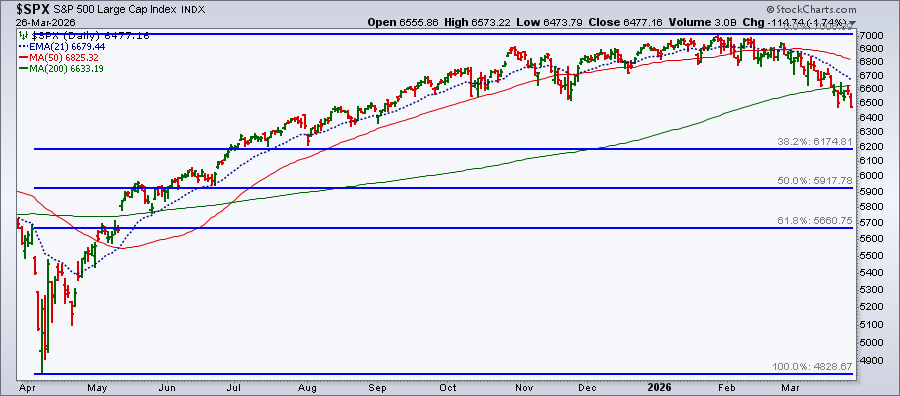
The next possible support is the 38.2 % Fibonacci level, around 6,174. You can draw this level with the line‑study tool.
Nasdaq Under Pressure
The Nasdaq Composite looks even weaker than the S&P 500.
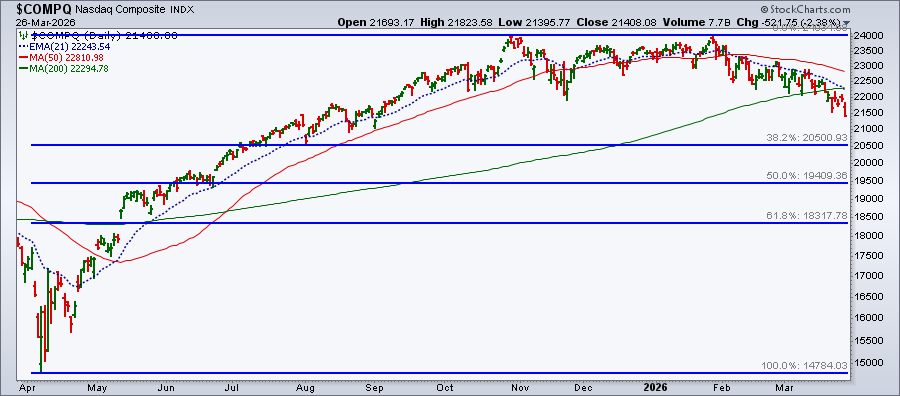
The index has closed below its 200‑day SMA for seven straight days. The last time it was this low was early September 2025. The 38.2 % Fibonacci level, around 20,500, is a key area to watch.
Dow Jones Follows the Same Trend
The Dow Jones Industrial Average shows a similar pattern.
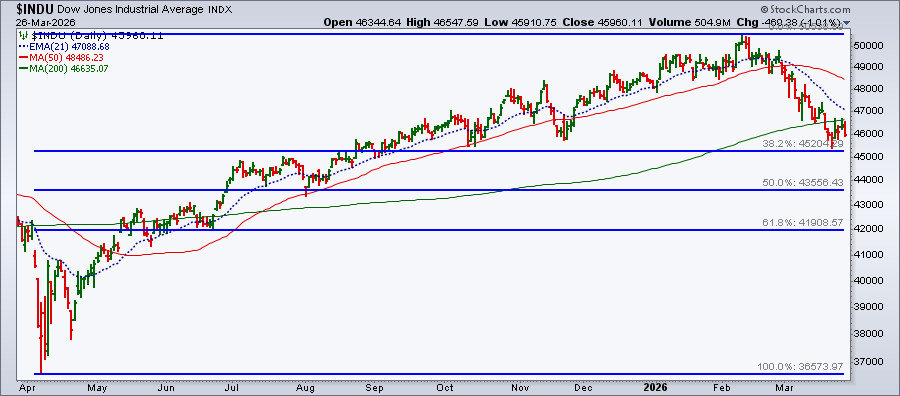
Like the other two indexes, the Dow sits below its 200‑day SMA and has bounced off the 38.2 % Fibonacci level. It is now moving back toward that level.
Overall, the three major indexes are in a clear downtrend. Buyers have not stepped in to change the direction. Without a real breakthrough in the Iran negotiations, selling pressure could keep going.
Even though a deadline for Iran‑U.S. talks was extended, the news only gave a tiny lift to futures. Traders need more than a short‑term headline boost to feel confident about buying.
What Comes Next?
The next few weeks are crucial. If the 38.2 % Fibonacci levels hold, we could see a bounce. If they break, the downtrend may continue. Watching these key levels will help you see whether bulls or bears are in charge.
Disclaimer: This article is for educational purposes only and does not constitute financial advice. Consult a qualified professional before making any investment decisions.
Source: Materials provided by https://articles.stockcharts.com.Note: Content may be edited for style and length.