

Quick Intro…
Ichimoku cloud breakouts are a powerful way to catch a new trend, but only when you verify the move with the right follow‑up. Scanners can spot the initial surge, yet many traders jump in too early and end up with shaky results. The missing piece is a second filter that confirms the breakout isn’t a false alarm.
The Real Issue: Over‑Simplified Teaching
Most online tutorials tell you that a price above the kumo (the cloud) automatically signals bullish momentum. While technically correct, that statement ignores a crucial question: Will the market sustain the higher price? A pure breakout tells you that resistance was broken, but it doesn’t guarantee the move will hold.
Consider these scenarios:
- Short sellers covering their positions
- A news headline causing a temporary spike
- Thin liquidity inflating the advance
- Late‑stage buyers chasing a weak rally
Because of these possibilities, experienced Ichimoku users wait for one more confirmation: a re‑acceptance of price above the Kijun‑sen.
Why the Kijun‑sen Matters
The Kijun‑sen reflects the medium‑term equilibrium of the market, calculated as the midpoint of the last 26 periods (roughly a month). It acts as a dynamic balance line where participants tend to agree on value.
If price stays above the Kijun‑sen after a cloud breakout, the market’s structure is genuinely bullish. Conversely, if the price can’t hold that level, the breakout is likely fragile. Therefore, waiting for a pull‑back that respects the Kijun‑sen adds a critical layer of confirmation.
Step‑by‑Step: Cloud Breakout + Kijun‑Sen Re‑Acceptance
The complete setup consists of four clear actions:
- Price pierces the top of the cloud.
- The move pulls back toward the Kijun‑sen.
- The Kijun‑sen holds as support, producing a bullish rejection candle.
- Momentum resumes upward, confirming the trend.
Only after the third step should you consider the trade valid. The Kijun‑sen bounce serves as the green light.
Visual Example: IWM
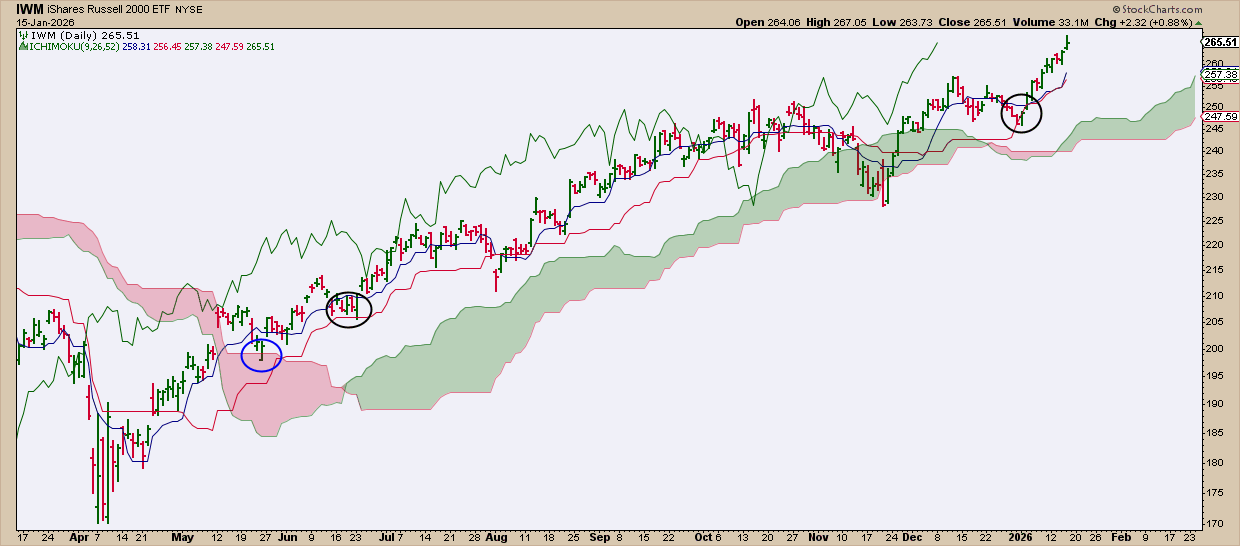
In May, the Russell 2000 ETF breached a thick bearish cloud. The first alert appears, but entry is postponed until the price retreats and bounces off the Kijun‑sen a few bars later. The same pattern repeats in January 2026, confirming that the Kijun‑sen has flipped from resistance to support.
What the Kijun‑Sen Filter Achieves
Adding the Kijun‑sen as a secondary filter provides three tangible benefits:
- Eliminates weak breakouts: Reduces exposure to bull traps.
- Boosts reward‑to‑risk: Offers a clear entry level and a natural stop just below the Kijun‑sen or cloud.
- Stays true to Ichimoku’s design: The system was built to illustrate trend, equilibrium and breakout context together.
Spotting the Setup on AAPL
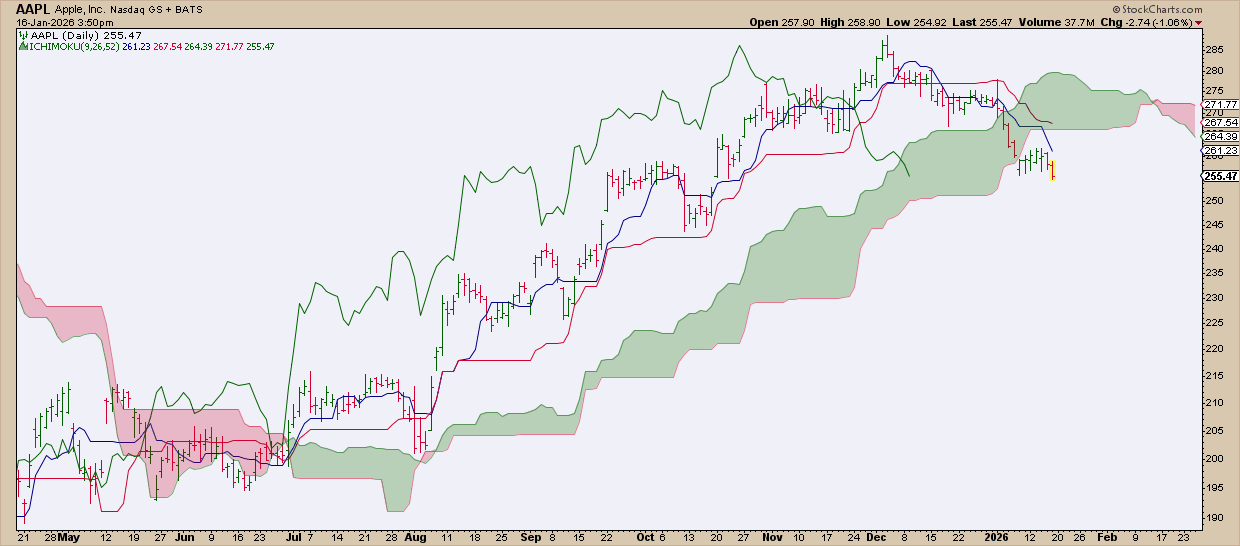
Apple’s chart displays multiple instances where the price re‑tests the Kijun‑sen, producing clean bullish rejection candles. Those moments also line up with Tenkan‑sen crossovers that can act as entry triggers, while the Kijun‑sen serves as a trailing stop.
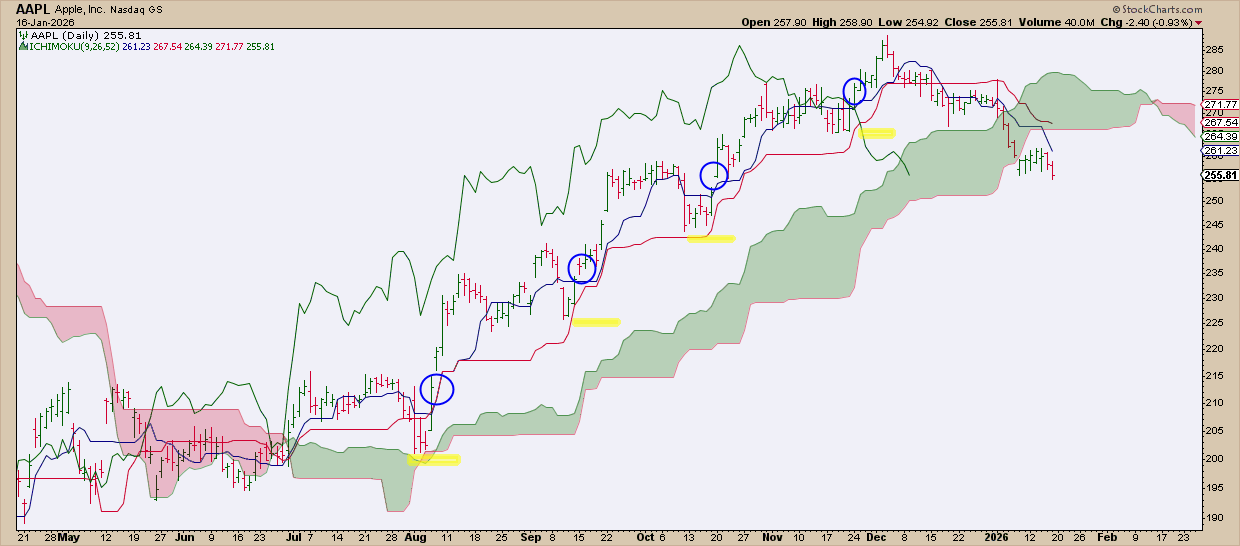
These annotations illustrate one trader’s perspective; your exact entry and exit levels may differ, but the underlying principle remains the same.
Quick Checklist for a Valid Kijun‑Sen Re‑Acceptance
- Price clears the cloud.
- Kijun‑sen sits beneath the price.
- A pull‑back toward the Kijun‑sen occurs.
- Small candles or hesitation appear at the Kijun‑sen.
- Price breaks higher with clear momentum.
If any element is missing, the trade does not meet the criteria and should be skipped.
Final Thoughts
The approach is straightforward, yet it adds a powerful layer of confirmation that many traders overlook. By waiting for the Kijun‑sen to re‑accept price after a cloud breakout, you filter out many false signals and focus on moves with genuine follow‑through. Remember: the breakout alone isn’t enough—use the Kijun‑sen as your final green light.
Source: Materials provided by https://articles.stockcharts.com.Note: Content may be edited for style and length.